A few months ago, I went to a meeting with Archbishop Hanus called the Priests’ council. This body brings together priests from different parts of the diocese in order for the Archbishop to articulate his vision and listen to the concerns of his people from various parts of the diocese. It was my responsibility to bring him the concerns of all the parishes close to Highway 30 from Tama to Ames, an area we call the Marshalltown deanery. Several of the priests had heard that the insurance rates for our parishes were going to increase dramatically so I was given the responsibility of asking about the particulars increase. The Archbishop and his advisors did a very comprehensive presentation that lasted for a few hours on Sunday night and again on Monday morning. Since I was the youngest person in the room, I thought it best to listen and not ask my question too early. Finally, toward the end of things, the Archbishop asked for questions. I raised my hand and asked about the insurance rates and saw this pained look come across his face. He acknowledged that the rates were likely going to triple because of the floods in Cedar Rapids, the tornado in Parkersburg, and the immigration raid in Postville. I was kind of taken aback because, while I could understand why natural disasters like floods and tornadoes would affect insurance, it had never occurred to me that federal agents raiding a processing plant would likewise affect insurance. So, being young and insatiably curious, I asked what the connection was. The same pained look deepened in the Archbishop’s face and he said that the government’s actions were a disaster. They separated families. People were afraid to go back to their homes out of fear that the government would leave their children and deport the illegal member to Mexico. There were rumors that a sizable immigrant population was living under a bridge in town because of the situation of fear. Up until this point, I have to admit that I was at least not entirely pro immigrant. I mean, don’t get me wrong. I wasn’t a xenophobe like Lou Dobbs. But, I believed that the government’s right to protect its borders meant that it should prosecute those people here illegally and send them back to their native countries. But, hearing the Archbishop tell us stories of families being separated, homes being abandoned, and individuals being punished while the producer finds a way to avoid persecution, just made me angry. And, what especially made me angry was when the Archbishop told us that he receives far more letters criticizing him over his stance on immigration than he ever did criticizing the church’s handling of the sexual abuse crisis.
We heard in the first reading today that the first gift of the Spirit was the gift of tongues. In the sixties, a group of very feeling-oriented spiritual people used this phrase almost exclusively about their particular spirituality. This charismatic spirituality involved a person being so overwhelmed by the Spirit that they start making what seems to most people as nonsense sounds. But, to the person involved in charismatic prayer, these nonsense sounds are a gift from the Spirit to show God’s presence to them. But, that’s not what is happening in the first reading. The first gift of tongues was, in a sense, a miraculous learning of other languages and dialects. It was a Rosetta Stone experience of learning a foreign language quickly and well. This happened in a way that seemed to reverse the Genesis experience of the tower of Babel in which the entire believing world was separated by words. Now, God the one who brought the Word into the world will bring the world together through words.
This unity of faith is what we have been given both as a gift and a responsibility. The Spirit is what guides us to help continue bringing about greater unity in the church. And, it is our responsibility to strive to bring that unity ever more fully to the church. One of my greatest frustrations about this country is that there are those who seem to believe that English is the only real language that exists. This attitude has become especially troublesome since the church made the concession of translating the mass into the vernacular. Whereas before 1960, it was obvious that the church was larger than the United States, was universal, because the entire mass was in Latin. Nowadays we only pray in English. We may occasionally pray Kyrie Eleison during Lent which is a Greek phrase. And we sing “Alleluia”, which is Aramaic…sort of. I fear that we are in danger of losing the mission given to us both in the first reading and the gospel, to bring ALL PEOPLE, not just Americans, together in Christ.
So, how do we get out of this? Let us listen to the Apostle Paul from the second reading. In that reading, Paul said, “As a body is one though it has many parts, and all the parts of the body, though many, are one body, so also Christ.” In other words, there is room for diversity amongst the unified body of Christ. There’s a part of me that wonders how we would react in most Catholic Church's in this country if the stranger was Latino, African, or Asian, especially if the person had a strange language or spirituality to go along with the strangeness of the color of their skin. This is as much if not more of a challenge to me as it is to anyone here: what are we doing to make the stranger to feel welcome, to be open to the diversity of gifts in order to bring together the one body of Christ?
Sunday, May 31, 2009


Friday, May 29, 2009
Some observations
I haven't been posting much recently. I'm honestly not sure why that is. I think I just don't remember to do it. There's definitely a lot that deserves mention. For instance, the supreme court of California didn't expand the definition of marriage to include relationships that aren't marriages. There's the new supreme court nominee...who I admit knowing nothing of. There's the stuff surrounding water boarding in which Mancow, the Chicago based radio talk show host, came to terms with the fact that it is torture after he had it done to him.
Personally, I went to the ordination last Sunday. I even preached about going there for Sunday mass. It was so awe inspiring. I didn't get to go last year for various reasons but I got to go this year and it really renewed my commitment to priesthood. I think I was especially receptive since I was coming off a week of vacation which consisted of camping and relaxing around Dubuque. But, it is just amazing that men still open themselves up to the possibility that God is calling them to be a priest. It is so edifying to realize that there will be others after me. And to feel the show of support for these young men as their family and friends come together reminds me of my own ordination seven years ago.
What made it even more special was that one of the ordinands and two of the servers have Iowa State connections. One of them, in fact, was here just last year. Even though this place can drive me crazy sometimes, men still find the path to God in the midst of this chaos. Praise God for working in the messiness of a hectic university setting!
Personally, I went to the ordination last Sunday. I even preached about going there for Sunday mass. It was so awe inspiring. I didn't get to go last year for various reasons but I got to go this year and it really renewed my commitment to priesthood. I think I was especially receptive since I was coming off a week of vacation which consisted of camping and relaxing around Dubuque. But, it is just amazing that men still open themselves up to the possibility that God is calling them to be a priest. It is so edifying to realize that there will be others after me. And to feel the show of support for these young men as their family and friends come together reminds me of my own ordination seven years ago.
What made it even more special was that one of the ordinands and two of the servers have Iowa State connections. One of them, in fact, was here just last year. Even though this place can drive me crazy sometimes, men still find the path to God in the midst of this chaos. Praise God for working in the messiness of a hectic university setting!
Sixth Sunday of Easter...God first loves us
My dear friends in Christ
Grace and love and peace to you in God our Father and the Lord Jesus Christ. I love spring. I love the fact that we aren’t going to get anymore snow on the ground. I love feeling the warmth of the sun on my head and arms as I sit next to my camper on a relaxing day off. There’s just something about this time of year that makes our readings explode of the page for me. LOVE! Our readings today are filled with love. It made me thing: it’s one thing to say that I love the sun. It’ s another thing to say, “I love you.” It’s a lot harder, a lot more intimate, isn’t. How do we show that we love one another?
There are safe ways to show love to one another. There’s the hand shake. There’s the high five. And, as we might remember from the election, there’s also the “fist bump” that the President and First Lady like to exchange. All of these are signs that are pretty safe to do with anyone you meet, right?
Then, there are more intimate ways of showing love. There’s the hug. Now I know some of you think that a hug should be bestowed on almost everyone and probably don’t agree that it’s more intimate. I can remember being seminary with just such a guy. At the end of a class where he had disagreed with a professor quite vehemently on a point, the seminarian wanted to hug the professor. The stuffy professor immediately fired back, “That’s why these tables are here, to prevent you from doing that! I think we’d all agree that a kiss is very intimate, right. It’ s not something you do for just anyone. During the next few months, I get to celebrate several wedding and, to be honest, my favorite part is when they exchange the kiss at the end of the liturgy. To me, this is something so beautiful about a man and woman exchanging that first kiss as husband and wife and doing so in front of the congregation of friends and family.
As I was praying about this, I asked myself, how do we show love to God? So far, none of the ways I talked about demonstrating love work for showing love to God. We can’t shake hands with God. We can’t hug God. We can’t fist bump God. So what can we do? We can sit in prayer and think in our hearts over and over again “I love you.” It’s really a powerful exercise and one that I encourage you to do sometime. But, that’s not very active. Love usually involves action. I show love by doing those simple actions to people. What are the actions I can do to show God love. What did our readings tell us to do?
“In this is love: not that we have loved God, but that he loved us and sent his son as an expiation for our sins.” This quote from the second reading today sums it all up. The point of love is not that we loved God but that he loves us and gave us his son so that we might life through him. Oftentimes with the sacrament of reconciliation, I hear people express statements that seem to infer that they have to earn God’s love. People seem to think that, since they haven’t done a good enough job as a Christian, God won’t love them anymore. But, that’s not possible. God is love. And God, who is love, cannot but love us. This amazing realization is what Peter was teaching in the Conelius’ house. This was so astounding to Cornelius that he felt like Peter himself must have been some kind of god, instead of just working for him. Peter’s reaction of lifting him and telling him that he is not a god would have seemed rather harsh to the people around. It reminds me of Pope John XXII who decided to abolish the tradition of kissing the pope’s feet. He didn’t want people bending over seeming to worship his feet just to show him honor and respect. A hug was better for John XXIII.
Nonetheless, even though God is love and loves us dearly, we are told that we need to live in God’s love. In other words, this doesn’t mean that our lives can be terrible and God sits by like a neglectful parent still loving even when the children are wreaking havoc on the neighborhood. We are told to keep the commandments. Of course, Jesus simplified them down for us to love God and love neighbor. All our life needs to be filled with this. We are told to lay down our lives for our friends. We shouldn’t put our own needs and comfort first, in other words. We need to be looking around to see who is in need in order to be of service to them. Lastly, we are told to go and bear fruit. To me, this is why I feel honored to be present when a man and woman express God’s love for them in marriage: because they can go forth and bear the fruit of children. It’s what makes the marriage of husband and wife unique and worth celebrating and why it is such an honor to watch them exchange their first kiss as husband and wife. For one second, we get to witness two people experiencing God’s love for them and it inspires us to live in that love too.
Grace and love and peace to you in God our Father and the Lord Jesus Christ. I love spring. I love the fact that we aren’t going to get anymore snow on the ground. I love feeling the warmth of the sun on my head and arms as I sit next to my camper on a relaxing day off. There’s just something about this time of year that makes our readings explode of the page for me. LOVE! Our readings today are filled with love. It made me thing: it’s one thing to say that I love the sun. It’ s another thing to say, “I love you.” It’s a lot harder, a lot more intimate, isn’t. How do we show that we love one another?
There are safe ways to show love to one another. There’s the hand shake. There’s the high five. And, as we might remember from the election, there’s also the “fist bump” that the President and First Lady like to exchange. All of these are signs that are pretty safe to do with anyone you meet, right?
Then, there are more intimate ways of showing love. There’s the hug. Now I know some of you think that a hug should be bestowed on almost everyone and probably don’t agree that it’s more intimate. I can remember being seminary with just such a guy. At the end of a class where he had disagreed with a professor quite vehemently on a point, the seminarian wanted to hug the professor. The stuffy professor immediately fired back, “That’s why these tables are here, to prevent you from doing that! I think we’d all agree that a kiss is very intimate, right. It’ s not something you do for just anyone. During the next few months, I get to celebrate several wedding and, to be honest, my favorite part is when they exchange the kiss at the end of the liturgy. To me, this is something so beautiful about a man and woman exchanging that first kiss as husband and wife and doing so in front of the congregation of friends and family.
As I was praying about this, I asked myself, how do we show love to God? So far, none of the ways I talked about demonstrating love work for showing love to God. We can’t shake hands with God. We can’t hug God. We can’t fist bump God. So what can we do? We can sit in prayer and think in our hearts over and over again “I love you.” It’s really a powerful exercise and one that I encourage you to do sometime. But, that’s not very active. Love usually involves action. I show love by doing those simple actions to people. What are the actions I can do to show God love. What did our readings tell us to do?
“In this is love: not that we have loved God, but that he loved us and sent his son as an expiation for our sins.” This quote from the second reading today sums it all up. The point of love is not that we loved God but that he loves us and gave us his son so that we might life through him. Oftentimes with the sacrament of reconciliation, I hear people express statements that seem to infer that they have to earn God’s love. People seem to think that, since they haven’t done a good enough job as a Christian, God won’t love them anymore. But, that’s not possible. God is love. And God, who is love, cannot but love us. This amazing realization is what Peter was teaching in the Conelius’ house. This was so astounding to Cornelius that he felt like Peter himself must have been some kind of god, instead of just working for him. Peter’s reaction of lifting him and telling him that he is not a god would have seemed rather harsh to the people around. It reminds me of Pope John XXII who decided to abolish the tradition of kissing the pope’s feet. He didn’t want people bending over seeming to worship his feet just to show him honor and respect. A hug was better for John XXIII.
Nonetheless, even though God is love and loves us dearly, we are told that we need to live in God’s love. In other words, this doesn’t mean that our lives can be terrible and God sits by like a neglectful parent still loving even when the children are wreaking havoc on the neighborhood. We are told to keep the commandments. Of course, Jesus simplified them down for us to love God and love neighbor. All our life needs to be filled with this. We are told to lay down our lives for our friends. We shouldn’t put our own needs and comfort first, in other words. We need to be looking around to see who is in need in order to be of service to them. Lastly, we are told to go and bear fruit. To me, this is why I feel honored to be present when a man and woman express God’s love for them in marriage: because they can go forth and bear the fruit of children. It’s what makes the marriage of husband and wife unique and worth celebrating and why it is such an honor to watch them exchange their first kiss as husband and wife. For one second, we get to witness two people experiencing God’s love for them and it inspires us to live in that love too.
Sunday, May 03, 2009
Post 600...The good shepherd wants the best for all his sheep
My dear brothers and sister in Christ
Grace and Peace in God, our Father through the good shepherd, Christ, in the power of the Spirit. I give thanks to God always for calling me to this ministry of presence with you. A few weeks ago, I was invited into one of our Religious Ed classrooms to answer questions from the students. I started off talking to them all about Holy Orders and then just answered general questions. After I had completed the closing prayer and thought we would all leave, one little girl said she had one more question. She said that, while driving with her mom, sometimes she sees a sign that says, “No salvation outside of Christ” and she and her mom both think that’s bad because it makes it seem like people in other religions are going to hell. I sat there for a second and tried to think of a one sentence, very short answer to her comment/question and just had to give up. I told her that I’d have to come back and talk about that some other time because it’s such a tough question to understand.
On this Fourth Sunday of Easter, we are confronted with this very question. The first reading today from the Acts of the Apostles tells of Peter’s speech to the Jewish leadership called the Sanhedrin. This same group had condemned Jesus and now they’re getting an ear full from Peter. At one point, Peter said of Jesus, “There is no salvation through anyone else, nor is there any other name under heaven given to the human race by which we are to be saved.” This seems to clearly state to what the sign says that the mother and daughter find so offensive. But, then we hear the gospel today and Jesus seems to leave the door open to dialogue on the subject. He says, “I have other sheep that do not belong to this fold. These also I must lead…” These seem like contradictory statements. Either only Christians will be in heaven or there are others that Jesus is leading to be with him in eternity. So, who is right?
Nine years ago, the Vatican released a controversial document entitled Dominus Jesus that, I believe can help us resolve this tension. It says, “It must therefore be firmly believed as a truth of Catholic faith that the universal salvific will of the One and Triune God is offered and accomplished once for all in the mystery of the incarnation, death, and resurrection of the Son of God.
Bearing in mind this article of faith, theology today, in its reflection on the existence of other religious experiences and on their meaning in God's salvific plan, is invited to explore if and in what way the historical figures and positive elements of these religions may fall within the divine plan of salvation...The Second Vatican Council, in fact, has stated that: ‘the unique mediation of the Redeemer does not exclude, but rather gives rise to a manifold cooperation which is but a participation in this one source’. The content of this participated mediation should be explored more deeply, but must remain always consistent with the principle of Christ's unique mediation: ‘Although participated forms of mediation of different kinds and degrees are not excluded, they acquire meaning and value only from Christ's own mediation, and they cannot be understood as parallel or complementary to his’. Hence, those solutions that propose a salvific action of God beyond the unique mediation of Christ would be contrary to Christian and Catholic faith.”
In other words, we do not believe that all other religions aside from Christianity are evil. But, we do believe that, if those religions have hope for salvation, it is because of Christ’s death, resurrection, and ascension. How do we work this out? Some theologians have put forward the notion of anonymous christianity. This means that, even though other people in other religions believe they aren’t Christian, they really are. It’s just that Christ is working anonymously in them to the extent that Christ, who is love, is working in them. I prefer to listen to Christ’s words. I sort of cropped off the end of the quote from earlier. He actually said, “I have other sheep that do not belong to this fold. These also I must lead, and they will hear my voice, and there will be one flock, one shepherd.” In other words, Christ is working to bring us together but it will only be when we are gathered together in the one fold, in heaven. As we continue to celebrate the joy-filled hope of resurrection during this Easter season, let us also continue to pray that Christ’s death and resurrection may lead to greater unity among all people who believe in God.
Grace and Peace in God, our Father through the good shepherd, Christ, in the power of the Spirit. I give thanks to God always for calling me to this ministry of presence with you. A few weeks ago, I was invited into one of our Religious Ed classrooms to answer questions from the students. I started off talking to them all about Holy Orders and then just answered general questions. After I had completed the closing prayer and thought we would all leave, one little girl said she had one more question. She said that, while driving with her mom, sometimes she sees a sign that says, “No salvation outside of Christ” and she and her mom both think that’s bad because it makes it seem like people in other religions are going to hell. I sat there for a second and tried to think of a one sentence, very short answer to her comment/question and just had to give up. I told her that I’d have to come back and talk about that some other time because it’s such a tough question to understand.
On this Fourth Sunday of Easter, we are confronted with this very question. The first reading today from the Acts of the Apostles tells of Peter’s speech to the Jewish leadership called the Sanhedrin. This same group had condemned Jesus and now they’re getting an ear full from Peter. At one point, Peter said of Jesus, “There is no salvation through anyone else, nor is there any other name under heaven given to the human race by which we are to be saved.” This seems to clearly state to what the sign says that the mother and daughter find so offensive. But, then we hear the gospel today and Jesus seems to leave the door open to dialogue on the subject. He says, “I have other sheep that do not belong to this fold. These also I must lead…” These seem like contradictory statements. Either only Christians will be in heaven or there are others that Jesus is leading to be with him in eternity. So, who is right?
Nine years ago, the Vatican released a controversial document entitled Dominus Jesus that, I believe can help us resolve this tension. It says, “It must therefore be firmly believed as a truth of Catholic faith that the universal salvific will of the One and Triune God is offered and accomplished once for all in the mystery of the incarnation, death, and resurrection of the Son of God.
Bearing in mind this article of faith, theology today, in its reflection on the existence of other religious experiences and on their meaning in God's salvific plan, is invited to explore if and in what way the historical figures and positive elements of these religions may fall within the divine plan of salvation...The Second Vatican Council, in fact, has stated that: ‘the unique mediation of the Redeemer does not exclude, but rather gives rise to a manifold cooperation which is but a participation in this one source’. The content of this participated mediation should be explored more deeply, but must remain always consistent with the principle of Christ's unique mediation: ‘Although participated forms of mediation of different kinds and degrees are not excluded, they acquire meaning and value only from Christ's own mediation, and they cannot be understood as parallel or complementary to his’. Hence, those solutions that propose a salvific action of God beyond the unique mediation of Christ would be contrary to Christian and Catholic faith.”
In other words, we do not believe that all other religions aside from Christianity are evil. But, we do believe that, if those religions have hope for salvation, it is because of Christ’s death, resurrection, and ascension. How do we work this out? Some theologians have put forward the notion of anonymous christianity. This means that, even though other people in other religions believe they aren’t Christian, they really are. It’s just that Christ is working anonymously in them to the extent that Christ, who is love, is working in them. I prefer to listen to Christ’s words. I sort of cropped off the end of the quote from earlier. He actually said, “I have other sheep that do not belong to this fold. These also I must lead, and they will hear my voice, and there will be one flock, one shepherd.” In other words, Christ is working to bring us together but it will only be when we are gathered together in the one fold, in heaven. As we continue to celebrate the joy-filled hope of resurrection during this Easter season, let us also continue to pray that Christ’s death and resurrection may lead to greater unity among all people who believe in God.
Thursday, April 30, 2009
Surrounded by first communion celebrations
Last weekend, at my little rural parish, I celebrate first communion. I had to get up very early (for me) and get there by 7:45 but the kids were just awesome. I love that little parish. I'm really learning who the families are out there since I've been in this assignment for four years. I can see the value of stability in this position. It would be really neat for me if I could be here long enough to watch the kids that I gave first communion to when I first got here be confirmed. I don't anticipate that will happen but one can dream.
This weekend I get to relive the experience, in a sense, by doing it for my University parish. The format is different but I love the excitement of the kids. Some of them have been watching their parents go up and receive for years and will now finally be able to do it themselves. I think it was at St. Thomas that there was a little kid who would go away crying each time he couldn't receive Jesus in the Holy Sacrament. I got to give that kid communion a year ago. I can't wait to see the surprises of who can receive this year.
This weekend I get to relive the experience, in a sense, by doing it for my University parish. The format is different but I love the excitement of the kids. Some of them have been watching their parents go up and receive for years and will now finally be able to do it themselves. I think it was at St. Thomas that there was a little kid who would go away crying each time he couldn't receive Jesus in the Holy Sacrament. I got to give that kid communion a year ago. I can't wait to see the surprises of who can receive this year.
Thursday, April 23, 2009
So, here's what happened last Sunday
It occurred to me that, even though Thomas' faith seemed to be at issue, the real thing that was lacking was Thomas love was lacking. If he really loved Jesus, he would have been excited to think that his friend was alive. But, his love didn't transcend death. I talked about how we need to be more loving in this world and allow that to define who we are so that, when people see us love, they will see Christ and be able to express with Thomas, "My Lord, and my God."
So I focused, in the end, on being loving instead of on personal prayer.
So I focused, in the end, on being loving instead of on personal prayer.
Monday, April 20, 2009
Sunday, April 19, 2009
The importance of being personal
My homily actually went in a slightly different direction than this in the end but this gives you an idea of what I originally had in mind. I'll talk about why I changed it mid weekend at some point this week.
My Dear Brothers and Sisters in Christ
May the Grace and Peace of our resurrected savior come upon you as we continue to celebrate his resurrection. He is risen! He is truly risen! Alleluia. Each Second Sunday of Easter, we hear the story of doubting Thomas. And, to be honest, I usually focus most of my preaching on the person of Thomas and ask you to put yourself in his place. In some ways, it’ easy to do that. Not only were none of us there when they crucified the Lord but none of us were there when he appeared to the twelve in the upper room. We all rely on the testimony of our ancestors in the faith, each year getting farther and farther and farther from their testimony. So, there is something to be said for focusing our attention on the saint of doubt-filled faith. But, as you probably suspect by now, the more I prayed this week about this, the more I found myself focusing on the other ten apostles.
Imagine for a second that you were the ones sitting in the upper room when Jesus appeared. You’re afraid because of the violent, cruel, and public death of your friend and leader and now you’re basically hiding away to make sure you don’t follow him down the road to crucifixion. Suddenly, when things seem totally hopeless, the very man you thought was dead is standing in your midst. You know he’s dead. You were with him when they came to arrest him. Your friends witnessed the murder and told you all about it. So how is he standing here just as Sr. Lorraine and the Bereavement Committee come walking up to your home to start preparing the funeral? You’re undoubtedly excited but you also confused and kind of freaked out. He’s not a ghost. He’s not a zombie. He’s not a mummy. He’s not an angel. He’s just Jesus, though not exactly like he was before. And, right once you work up the nerve to say, “So, what the heck is going on here, friend?” he disappears.
Of course you’d have to be excited and would want to share this with others. But, what do you say? How could you explain to people that the person they saw brutally murdered just three days before appeared to you and shared a meal? I know, personally, I’d start with my closest friends and see how that goes before I start telling the general public and end up in a straight jacket. Let’s start with the one apostle not in the room, Thomas. But, when we tell him, he doesn’t believe what we’ve said and he won’t believe until he can probe the wounds and see for himself that it is Jesus. “Gosh,” I may say to myself, “I didn’t probe his wounds. Am I even sure that this was really Jesus?” And suddenly, even we who had seen the risen Lord are doubting that are actually have. In my mind, this is where we are. Sure, as I said before, none of us have ever had direct contact with Jesus. None of us have ever walked with him. But, hopefully, all of us have encountered him in prayer. All of us encounter him in this upper room of the church in the sacrament of his body and blood. All of us encounter him where two or three are gathered together. Yet, there is a sense of mystery about it each of these experiences. In prayer, we both have faith that Christ is present and wonder if this is just our imagination doing all the work. In the sacraments, we are told that it’s Jesus’ body and blood but it looks a lot like bread and wine to me. And, if this is the gathered body of Christ on earth, why are there so many sinners, myself included?
In some ways, life would be a lot easier if we could somehow recreate the situation from the first reading. This passage that I like to refer to as the part of the Bible that fundamentalists ignore, harkens back to a time when the church was still very small and it was expected that the end was near. So, since Jesus is going to return tomorrow, they sold all their stuff and lived in common, each person sharing what they have with the rest of the community. Fortunately or unfortunately, we don’t live in that same situation. And, to be honest, oftentimes, when we turn to our friends and neighbors to support our faith, they simply raise even more doubts, complaining about church teachings or figures within the church that they don’t like. It’s, in some way, the down side to being a part of a 1.31 billion person religion. Sometimes, you may feel more burdened by the people in your community than uplifted, like the apostles were by Thomas. In these times, I believe we are called to enter even more deeply into our upper rooms in personal prayer. Make the time each day to make room for the encounter with God so that our communal celebration on Sunday is even more profound. That way, when our faith is tested by the doubting Thomases of our world, we can remain strong and remain in the faith, which has been handed on to us by our ancestors and, in turn, hand it on to others.
My Dear Brothers and Sisters in Christ
May the Grace and Peace of our resurrected savior come upon you as we continue to celebrate his resurrection. He is risen! He is truly risen! Alleluia. Each Second Sunday of Easter, we hear the story of doubting Thomas. And, to be honest, I usually focus most of my preaching on the person of Thomas and ask you to put yourself in his place. In some ways, it’ easy to do that. Not only were none of us there when they crucified the Lord but none of us were there when he appeared to the twelve in the upper room. We all rely on the testimony of our ancestors in the faith, each year getting farther and farther and farther from their testimony. So, there is something to be said for focusing our attention on the saint of doubt-filled faith. But, as you probably suspect by now, the more I prayed this week about this, the more I found myself focusing on the other ten apostles.
Imagine for a second that you were the ones sitting in the upper room when Jesus appeared. You’re afraid because of the violent, cruel, and public death of your friend and leader and now you’re basically hiding away to make sure you don’t follow him down the road to crucifixion. Suddenly, when things seem totally hopeless, the very man you thought was dead is standing in your midst. You know he’s dead. You were with him when they came to arrest him. Your friends witnessed the murder and told you all about it. So how is he standing here just as Sr. Lorraine and the Bereavement Committee come walking up to your home to start preparing the funeral? You’re undoubtedly excited but you also confused and kind of freaked out. He’s not a ghost. He’s not a zombie. He’s not a mummy. He’s not an angel. He’s just Jesus, though not exactly like he was before. And, right once you work up the nerve to say, “So, what the heck is going on here, friend?” he disappears.
Of course you’d have to be excited and would want to share this with others. But, what do you say? How could you explain to people that the person they saw brutally murdered just three days before appeared to you and shared a meal? I know, personally, I’d start with my closest friends and see how that goes before I start telling the general public and end up in a straight jacket. Let’s start with the one apostle not in the room, Thomas. But, when we tell him, he doesn’t believe what we’ve said and he won’t believe until he can probe the wounds and see for himself that it is Jesus. “Gosh,” I may say to myself, “I didn’t probe his wounds. Am I even sure that this was really Jesus?” And suddenly, even we who had seen the risen Lord are doubting that are actually have. In my mind, this is where we are. Sure, as I said before, none of us have ever had direct contact with Jesus. None of us have ever walked with him. But, hopefully, all of us have encountered him in prayer. All of us encounter him in this upper room of the church in the sacrament of his body and blood. All of us encounter him where two or three are gathered together. Yet, there is a sense of mystery about it each of these experiences. In prayer, we both have faith that Christ is present and wonder if this is just our imagination doing all the work. In the sacraments, we are told that it’s Jesus’ body and blood but it looks a lot like bread and wine to me. And, if this is the gathered body of Christ on earth, why are there so many sinners, myself included?
In some ways, life would be a lot easier if we could somehow recreate the situation from the first reading. This passage that I like to refer to as the part of the Bible that fundamentalists ignore, harkens back to a time when the church was still very small and it was expected that the end was near. So, since Jesus is going to return tomorrow, they sold all their stuff and lived in common, each person sharing what they have with the rest of the community. Fortunately or unfortunately, we don’t live in that same situation. And, to be honest, oftentimes, when we turn to our friends and neighbors to support our faith, they simply raise even more doubts, complaining about church teachings or figures within the church that they don’t like. It’s, in some way, the down side to being a part of a 1.31 billion person religion. Sometimes, you may feel more burdened by the people in your community than uplifted, like the apostles were by Thomas. In these times, I believe we are called to enter even more deeply into our upper rooms in personal prayer. Make the time each day to make room for the encounter with God so that our communal celebration on Sunday is even more profound. That way, when our faith is tested by the doubting Thomases of our world, we can remain strong and remain in the faith, which has been handed on to us by our ancestors and, in turn, hand it on to others.
Friday, April 17, 2009
A truly Catholic student at Notre Dame!
One of my brother priests told me about this story from the Des Moines Register about a student from Notre Dame who is skipping his graduation in order to stay in the church and pray for the commencement speaker, President Obama. Now, I'm sure that there will be those who will immediately label it as racism but, to me, it's encouraging.
When the leaders of institutions like Notre Dame refuse to make Catholic theology a priority and reward people who support abortion and stem cell research with honors, it really goes to show how pathetic the Vatican II generation is at promoting a catholic world view. They claim this will open up a dialogue with him but it will not. You can't dialogue with a politician any more than you can dialogue with a terrorist. If we want to dialogue with them, we don't invite them to campus to preach and then give them an honorary doctorate. We invite them to sit on a panel debating the merits of infanticide and give them a certificate of participation or something. But this attitude that we need to engage the modern world by letting them preach the gospel of death on our campuses is just ridiculous.
I'm especially proud that this is an Iowan who is standing up here and doing what is right. We should pray for him and for his parents because the progressive side of the Catholic Church cannot tolerate orthodoxy. You can believe whatever you want but you cannot possibly uphold the teachings of the Catholic Church. This young man is going to be harassed. Pray that he stay strong.
When the leaders of institutions like Notre Dame refuse to make Catholic theology a priority and reward people who support abortion and stem cell research with honors, it really goes to show how pathetic the Vatican II generation is at promoting a catholic world view. They claim this will open up a dialogue with him but it will not. You can't dialogue with a politician any more than you can dialogue with a terrorist. If we want to dialogue with them, we don't invite them to campus to preach and then give them an honorary doctorate. We invite them to sit on a panel debating the merits of infanticide and give them a certificate of participation or something. But this attitude that we need to engage the modern world by letting them preach the gospel of death on our campuses is just ridiculous.
I'm especially proud that this is an Iowan who is standing up here and doing what is right. We should pray for him and for his parents because the progressive side of the Catholic Church cannot tolerate orthodoxy. You can believe whatever you want but you cannot possibly uphold the teachings of the Catholic Church. This young man is going to be harassed. Pray that he stay strong.
Tuesday, April 14, 2009
A Blessed Triduum and good start to Easter
For some reason this year, I decided that I wasn't going to update too quickly on my Holy Thursday, Good Friday, and Easter Sunday experience. So, here it is...
I was out at my little rural parish, which tends to be more "in step" with the way I like to celebrate these "high holy days" of the church year. Holy Thursday had a small congregation of mainly the core members. There were probably somewhere between 50 and 75 people there. I love this mass since it is one where I wash the feet of twelve parishioners in the same way that Jesus washed the feet of his disciples. It's a liturgy that, for me, focuses on the role of the priest in the community.
Good Friday was beautiful, although I forgot to take the Good Friday collection for the Holy Land for the second year in a row. If we lose Beit Jala this year to the Saracens, it's all my fault! No, but in all seriousness, I feel bad for not doing it, especially since the Holy Land was such a formative place for my faith. The carrying of the cross and veneration of that cross is so tied to Jerusalem and the church of the Holy Sepulcher that I can't believe I forgot.
I decided not to attend the Easter Vigil this year. I won't get many years where that will be possible so I decided to do it this year. But that meant that I started Easter on Sunday morning, which seemed a little strange. Nonetheless, the absence of an Easter Vigil was deftly made up for by my little rural parish. Incense! Candles! Easter Candle! Renewal of Baptismal Promises! Chanting all the prayers! Alleluia! It was incredible. It sort of confirmed for me that I really do hope to be a pastor someday. I made the decisions out there, which means I followed what the book calls for. It really felt celebratory.
He is Risen! He is truly Risen!
I was out at my little rural parish, which tends to be more "in step" with the way I like to celebrate these "high holy days" of the church year. Holy Thursday had a small congregation of mainly the core members. There were probably somewhere between 50 and 75 people there. I love this mass since it is one where I wash the feet of twelve parishioners in the same way that Jesus washed the feet of his disciples. It's a liturgy that, for me, focuses on the role of the priest in the community.
Good Friday was beautiful, although I forgot to take the Good Friday collection for the Holy Land for the second year in a row. If we lose Beit Jala this year to the Saracens, it's all my fault! No, but in all seriousness, I feel bad for not doing it, especially since the Holy Land was such a formative place for my faith. The carrying of the cross and veneration of that cross is so tied to Jerusalem and the church of the Holy Sepulcher that I can't believe I forgot.
I decided not to attend the Easter Vigil this year. I won't get many years where that will be possible so I decided to do it this year. But that meant that I started Easter on Sunday morning, which seemed a little strange. Nonetheless, the absence of an Easter Vigil was deftly made up for by my little rural parish. Incense! Candles! Easter Candle! Renewal of Baptismal Promises! Chanting all the prayers! Alleluia! It was incredible. It sort of confirmed for me that I really do hope to be a pastor someday. I made the decisions out there, which means I followed what the book calls for. It really felt celebratory.
He is Risen! He is truly Risen!
Thursday, April 09, 2009
A blast from the past
So, as a kid, I was fascinated with this song. Maybe it will dislodge some memories...or just drive you crazy with its repetitive rhythms. In any case, pop goes the world!
Monday, April 06, 2009
The view from my porch...yuck
This is what I saw this afternoon from my porch. It started to snow sometime before seven because, as of seven a.m., there was a layer on the ground.

Welcome to spring in Iowa!

Welcome to spring in Iowa!
Sunday, April 05, 2009
Statement of the Iowa Catholic bishops regarding the Iowa Supreme Court decision
We, the Roman Catholic Bishops of Iowa, strongly disagree with the decision of the Iowa Supreme Court which strikes down Iowa's law defining marriage as a union of one man and one woman. This decision rejects the wisdom of thousands of years of human history. It implements a novel understanding of marriage, which will grievously harm families and children.
This unwarranted social engineering attacks the good that marriage offers to society, especially the good of children, and weakens the critical relationship between marriage and parenting. We will resolutely continue to protect and promote marriage as a union between a man and a woman because of its unique and historical contribution to the common good.
We uphold the right of all people to be treated with respect and live in peace. This right, like the right to enter into a permanent, monogamous marriage of one man and one woman, derives directly from the intrinsic dignity of the human person. These are rights which the state has the duty to recognize and protect. They are not something that the state creates or may redefine. The citizens of every state who have been given the opportunity have voted to preserve civil marriage as it has been recognized and defined since the beginning of recorded history.
Therefore, we exhort Catholics and other citizens of Iowa to recognize the clear need for a constitutional amendment on marriage. We affirm that supporting the ideal of marriage as the stable union of one man and one woman is necessary to defend marriage, families, children, and the common good.
Most Rev. Jerome Hanus, OSB, Archbishop of Dubuque
Most Rev. R. Walker Nickless, Bishop of Sioux City
Most Rev. Martin Amos, Bishop of Davenport
Most Rev. Richard Pates, Bishop of Des Moines
[For a fuller explanation of our position, check the "Statements" section on the website of the Iowa Catholic Conference, www.iowacatholicconference.org. An alert is available in the Action Center.]
This unwarranted social engineering attacks the good that marriage offers to society, especially the good of children, and weakens the critical relationship between marriage and parenting. We will resolutely continue to protect and promote marriage as a union between a man and a woman because of its unique and historical contribution to the common good.
We uphold the right of all people to be treated with respect and live in peace. This right, like the right to enter into a permanent, monogamous marriage of one man and one woman, derives directly from the intrinsic dignity of the human person. These are rights which the state has the duty to recognize and protect. They are not something that the state creates or may redefine. The citizens of every state who have been given the opportunity have voted to preserve civil marriage as it has been recognized and defined since the beginning of recorded history.
Therefore, we exhort Catholics and other citizens of Iowa to recognize the clear need for a constitutional amendment on marriage. We affirm that supporting the ideal of marriage as the stable union of one man and one woman is necessary to defend marriage, families, children, and the common good.
Most Rev. Jerome Hanus, OSB, Archbishop of Dubuque
Most Rev. R. Walker Nickless, Bishop of Sioux City
Most Rev. Martin Amos, Bishop of Davenport
Most Rev. Richard Pates, Bishop of Des Moines
[For a fuller explanation of our position, check the "Statements" section on the website of the Iowa Catholic Conference, www.iowacatholicconference.org. An alert is available in the Action Center.]
Friday, April 03, 2009
I'm just frustrated.
Today the state of Iowa decided that equal protection under the law meant that they had the right to turn marriage into a relationship that does not involve the possibility of involving new human life. Marriage no longer has to do with a husband and a wife who are capable of having children and, because of the uniqueness of that relationship, it deserves some protection. Now it just has to do with two people that think they love one another right now, regardless of their sex.
The worst thing is that children will suffer for this. We already see children as accidental consequences of recreational activities. Now, since this ruling basically solidifies that marriage should not involve them, we will continue to look upon them as disposable unless they are totally, one hundred percent wanted.
And, of course, since we cannot imagine a situation in which everyone gets whatever they want whenever they want it wherever they want it, the church is going to have to figure out some sort of way to deal with lawsuits that will inevitably come from gays and lesbians denied marriage in the church. We may lose our hospitals by refusing to perform abortions. Will we soon have to forsake a sacrament by refusing to marry gays?
The worst thing is that children will suffer for this. We already see children as accidental consequences of recreational activities. Now, since this ruling basically solidifies that marriage should not involve them, we will continue to look upon them as disposable unless they are totally, one hundred percent wanted.
And, of course, since we cannot imagine a situation in which everyone gets whatever they want whenever they want it wherever they want it, the church is going to have to figure out some sort of way to deal with lawsuits that will inevitably come from gays and lesbians denied marriage in the church. We may lose our hospitals by refusing to perform abortions. Will we soon have to forsake a sacrament by refusing to marry gays?
Thursday, April 02, 2009
What were you doing four years ago?

Four years ago today, I was helping with a TEC retreat at Wahlert High School. During that year, I was very ambitious. I was associate pastor for one parish and I helped out in five others. It was a good time but very busy as well. I was asked to help with this retreat and I said yes before I really thought about the consequences. It would make more sense if the guy who was associate pastor for one parish. But I decided to do it. During one of the breaks, the priest leader (who I was helping) had us all go to the media room of Wahlert High School and he told us that Pope John Paul II was not expected to live much longer. He had put together a power point presentation on the life of JP II and led us in prayer. The Pope died shortly thereafter.
I've said this before and I think it's doubly true today. During his life, I didn't know his writing well. He was the pope for my growing up years but I had no real idea of the theology of the body or how he really carried on the reforms of the Vatican II or all the many encyclicals he wrote. But, for three years of my priesthood I prayed for John Paul, our Pope because that's who he was. A Pope for us all. A gift given by God to his church to lead through tough times. Four years ago, I was going the same thing I am doing today: joining with the chorus of voices chanting "Santo Subito!" True holiness is easily seen in the life and love of JPII.
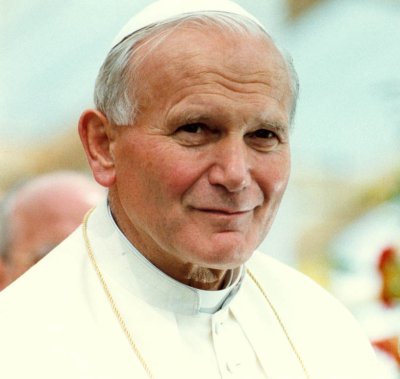
JPII: We love you!
Wednesday, April 01, 2009
My annual Lenten cold arrives
Sorry about not posting my homily this weekend. To sum up, I talked about the grain of wheat that falls to the earth and dies but remains a grain of wheat. I preached in my little rural parish and told them that I'm always leery of getting too agrarian in my homilies out of fear since I'm a city slicker. I am always concerned that I'm going to sound like the guy who owns a dog lecturing at a dog catcher's conference.
In any case, I awoke last night with a scratchy, dry throat and realized that my annual Lenten cold has arrive. It tends to show up around now and stick around the third or fourth week of Easter. I attribute it to the changing seasons and the stress associated with that. The good thing is that it gives me more sympathy for the sick. I hate having a cold. I can't imagine how difficult and frustrating it would be to have to live with sickness all the time.
In any case, I awoke last night with a scratchy, dry throat and realized that my annual Lenten cold has arrive. It tends to show up around now and stick around the third or fourth week of Easter. I attribute it to the changing seasons and the stress associated with that. The good thing is that it gives me more sympathy for the sick. I hate having a cold. I can't imagine how difficult and frustrating it would be to have to live with sickness all the time.
Friday, March 27, 2009
more from Zenit.org
I've been taking some time recently to get caught up on catholic news ever since the entire controversy regarding the Pope's comments about condoms almost entirely passed me by. So, while perusing, I found this story about how Great Britain is going to advertise for abortion. The bishops there are appalled. I wonder what the point is. Do we advertise for heart bypass surgery? Do we advertise for breast reduction surgery? If, as the pro-abortion forces say, it is a medical procedure, then why would you advertise for it?
But, that's sort of the point isn't it? They want it to be advertised so that people will think it's just a normal part of life. They want to remove the guilt that people feel when they murder someone by making it seem like any other normal thing. It's just like buying life insurance, or getting a fish sandwich from McDonalds.
But, of course, it's not and I think people will see that. We know murder when we see it. We might not like to admit it but a commercial isn't going to convince someone that abortion is just like going to an amusement park anymore than a commercial for a gun seller is going to convince people that guns don't kill people.
But, that's sort of the point isn't it? They want it to be advertised so that people will think it's just a normal part of life. They want to remove the guilt that people feel when they murder someone by making it seem like any other normal thing. It's just like buying life insurance, or getting a fish sandwich from McDonalds.
But, of course, it's not and I think people will see that. We know murder when we see it. We might not like to admit it but a commercial isn't going to convince someone that abortion is just like going to an amusement park anymore than a commercial for a gun seller is going to convince people that guns don't kill people.
Thursday, March 26, 2009
The Pope and condoms
In case you didn't hear, the pope recently visited Africa and, among other things, said that Africa didn't condoms to stop the spread of Aids. Of course, people flipped out. The obvious solution to AIDS is condoms, right. I found a very interesting article on zenit.org that commented the following on that attitude from a woman working in Africa.
"The Pope," Busingye emphasized, "is doing nothing else but defending and supporting precisely that which will be useful for helping these people: affirming the meaning of life and the dignity of the human being."
She continued: "Those who attack him have interests to defend, but the Pope has no such interests: he is concerned about us, and he is concerned about Africa.
"He is not the one, who is bringing mines to blow up our children, our children who become soldiers, who become amputees, without ears, without mouths, unable to swallow saliva: and what should we give them, condoms?
"When a few years ago there was genocide in Rwanda, everyone stood by and watched. Nearby there is a tiny town, which could have been protected, and no one did anything.
"My relatives were there, and they all died in an inhumane way. No one cared, and now they are coming here with condoms."
"The Pope," Busingye emphasized, "is doing nothing else but defending and supporting precisely that which will be useful for helping these people: affirming the meaning of life and the dignity of the human being."
She continued: "Those who attack him have interests to defend, but the Pope has no such interests: he is concerned about us, and he is concerned about Africa.
"He is not the one, who is bringing mines to blow up our children, our children who become soldiers, who become amputees, without ears, without mouths, unable to swallow saliva: and what should we give them, condoms?
"When a few years ago there was genocide in Rwanda, everyone stood by and watched. Nearby there is a tiny town, which could have been protected, and no one did anything.
"My relatives were there, and they all died in an inhumane way. No one cared, and now they are coming here with condoms."
Wednesday, March 25, 2009
Have you ever seen this picture?

I was sent an email that contained this picture this morning.
Sometimes God sends both a man and a woman to call his people to holiness.
Benedict and Scholastica
Francis and Claire
Mary and Jesus
Our generation has these: John Paul the Great and Mother Teresa. One fell the scourge of communism. The other served the poor in India one person at a time. The influence of both will be felt for generations.
What I really like about this picture is the joy reflected in their faces. I get the sense that they aren't Brad and Angelina posing for paparazzi. They are expressing the hope that is inherent in their life of faith.
Sunday, March 22, 2009
We don’t need to earn God’s salvation but we still have to do good works
My Dear Brothers and Sisters in Christ
Grace to you and Peace in Christ Jesus, our Lord, as we continue on our Lenten journey of prayer, fasting, and almsgiving. In today’s readings, we hear three difficult passages that challenge our conceptions of God’s relationship to us and our relationship to God. In fact, the second reading and gospel are favorite passages of our Protestant brothers and sisters. You may recognize the gospel as the oft cited John 3:16 from sporting events, “For God so loved the world that he gave his only begotten son so that those who might believe in him might not die but have eternal life.” On the other hand, one could argue that the second reading from Saint Paul’s letter to the Ephesians was the passage that caused the Reformation. So, this Sunday more than most, I’m going to do something that I don’t normally do: I’m going to focus on a reading other than the gospel for this homily and see what we can understand from that reading that may help us understand better the gospel.
The letter of Paul to the Ephesians is very interesting, not the least reason being that the title may be a complete fabrication. Several scholars don’t even believe Paul wrote this letter, preferring it to have been written by one of Paul’s disciples after the apostle’s death and given his attribution since most of the theology was based on his teaching. Further, the letter may not have been intended for the Ephesians at all. The earliest manuscripts have no notation as to its destination. Marcion, an anti-Semitic early church heretic, said that it was to the Laodicians. Oftentimes, when Paul writes a letter to a specific community, there are names of people he has met there that he wants to greet. However, in this letter, he only ever greets one person, a fellow named Tychicus. Now, imagine for a second that you had lived in a town for three years and spent a lot of time with the leaders of the town helping them to convert to Christianity. You made tents during the day but you spent a lot of time at night and during both Sabbaths (Saturday for the Jews and Sunday for the Christians) evangelizing. Wouldn’t you think you would have a ton of people he would want to greet? I think, if anything, there were just too many to mention.
I mention these two controversies because I think they help us understand a bit of the controversy surrounding this letter and, perhaps, a bit of what we need to understand about this letter in our own day. If Paul did write this letter, he did it basically on his deathbed. And, he did so with a yearning for “better days.” And, he may have done so wishing that he could have done things a little better. You may remember from a few weeks ago, Paul had to defend himself against charges that he was lazy. He made a promise to return to the Corinthians and he couldn’t quite get there so he sent a second letter instead. Paul has regrets that he failed in ministry, that some didn’t hear the gospel because he couldn’t keep on evangelizing. Did Paul fail in gaining heaven because of this failure in ministry?
In some ways, in the passage we read from the letter to the Ephesians, Paul is answering the question of how much we have to do in order to earn salvation. Paul’s answer: there is nothing we CAN do to EARN salvation. Salvation is freely offered to us in Christ. He says, “For by grace you have been saved through faith, and this is not from you; it is the gift of God; it is not from works, so no one may boast.” It’s not as though my giving up pop for Lent has saved me. Jesus Christ’s death on the cross is the life-giving sacrifice that ends all sacrifices. He is the Lamb of God who takes away the sins of the world. He is the light that conquers all darkness. He is the word that breaks the silence of doubt. Jesus alone can save us.
And yet, does this mean that we are left entirely off the hook? Does it mean that the people who just spent an entire week serving the poor on spring break didn’t earn salvation by doing that? Yes it does. We can’t earn heaven. We can, however, cooperate with the gift that is offered to us. For, even though we don’t earn heaven by doing good works, Paul says in the very next sentence, “For we are his handiwork, created in Christ Jesus for the good works that God has prepared in advance, that we should live in them.” As believers, God points out to us certain things that we should do in order to grow in the grace that he offers us. Just like a gifted athlete or musician or architect or janitor still needs to train each day and grow in that gift, so we Christians must continue to grow in grace throughout our lives. And, the amazing thing is that God has kind of set us up for these good works. Even the good works we do are really prepared for us by God. The sense of injustice at seeing flood damaged areas after Hurricane Katrina has forced people to work for those who have been homeless for years. The sense of injustice at seeing places of deep poverty in our own country as is present the Appalachia mountains. The sense of injustice that our politicians take private planes while deriding those who come before them in the same private planes and while ignoring those who, in Washington D.C., are incredibly poor and destitute. The sense of injustice at seeing people in our own state ravaged by floods in Cedar Rapids being ignored while their homes and businesses remain abandoned and unlivable. God planted this sense of injustice in the hearts of some of our parishioners and it forced them to do good works. They heard the call of God to reach out in loving service to do good works for those in need in those places I listed and we thank them for representing this community and for listening so intently to God’s voice calling them to that service. But, thankfully, that call to do good works does not simply exist in these exceptional calls to go somewhere else and show God’s love to a foreign people. It happens in our daily lives, we just need to be intent enough to listen. That’s why the church continues the call that our Jewish brothers and sisters received so long ago. Prayer, fasting, and almsgiving. Prayer is where we hear the voice of God. Fasting is what leaves space in our crowded lives. Almsgiving is where we fill that space with the love of God lived out in good works. It is truly by grace that we have been saved through faith. It is not from us; it is the gift of God; it is not from works, so no one may boast. For we are his handiwork, created in Christ Jesus for the good works that God has prepared in advance, that we should (find eternal life) in them.
Grace to you and Peace in Christ Jesus, our Lord, as we continue on our Lenten journey of prayer, fasting, and almsgiving. In today’s readings, we hear three difficult passages that challenge our conceptions of God’s relationship to us and our relationship to God. In fact, the second reading and gospel are favorite passages of our Protestant brothers and sisters. You may recognize the gospel as the oft cited John 3:16 from sporting events, “For God so loved the world that he gave his only begotten son so that those who might believe in him might not die but have eternal life.” On the other hand, one could argue that the second reading from Saint Paul’s letter to the Ephesians was the passage that caused the Reformation. So, this Sunday more than most, I’m going to do something that I don’t normally do: I’m going to focus on a reading other than the gospel for this homily and see what we can understand from that reading that may help us understand better the gospel.
The letter of Paul to the Ephesians is very interesting, not the least reason being that the title may be a complete fabrication. Several scholars don’t even believe Paul wrote this letter, preferring it to have been written by one of Paul’s disciples after the apostle’s death and given his attribution since most of the theology was based on his teaching. Further, the letter may not have been intended for the Ephesians at all. The earliest manuscripts have no notation as to its destination. Marcion, an anti-Semitic early church heretic, said that it was to the Laodicians. Oftentimes, when Paul writes a letter to a specific community, there are names of people he has met there that he wants to greet. However, in this letter, he only ever greets one person, a fellow named Tychicus. Now, imagine for a second that you had lived in a town for three years and spent a lot of time with the leaders of the town helping them to convert to Christianity. You made tents during the day but you spent a lot of time at night and during both Sabbaths (Saturday for the Jews and Sunday for the Christians) evangelizing. Wouldn’t you think you would have a ton of people he would want to greet? I think, if anything, there were just too many to mention.
I mention these two controversies because I think they help us understand a bit of the controversy surrounding this letter and, perhaps, a bit of what we need to understand about this letter in our own day. If Paul did write this letter, he did it basically on his deathbed. And, he did so with a yearning for “better days.” And, he may have done so wishing that he could have done things a little better. You may remember from a few weeks ago, Paul had to defend himself against charges that he was lazy. He made a promise to return to the Corinthians and he couldn’t quite get there so he sent a second letter instead. Paul has regrets that he failed in ministry, that some didn’t hear the gospel because he couldn’t keep on evangelizing. Did Paul fail in gaining heaven because of this failure in ministry?
In some ways, in the passage we read from the letter to the Ephesians, Paul is answering the question of how much we have to do in order to earn salvation. Paul’s answer: there is nothing we CAN do to EARN salvation. Salvation is freely offered to us in Christ. He says, “For by grace you have been saved through faith, and this is not from you; it is the gift of God; it is not from works, so no one may boast.” It’s not as though my giving up pop for Lent has saved me. Jesus Christ’s death on the cross is the life-giving sacrifice that ends all sacrifices. He is the Lamb of God who takes away the sins of the world. He is the light that conquers all darkness. He is the word that breaks the silence of doubt. Jesus alone can save us.
And yet, does this mean that we are left entirely off the hook? Does it mean that the people who just spent an entire week serving the poor on spring break didn’t earn salvation by doing that? Yes it does. We can’t earn heaven. We can, however, cooperate with the gift that is offered to us. For, even though we don’t earn heaven by doing good works, Paul says in the very next sentence, “For we are his handiwork, created in Christ Jesus for the good works that God has prepared in advance, that we should live in them.” As believers, God points out to us certain things that we should do in order to grow in the grace that he offers us. Just like a gifted athlete or musician or architect or janitor still needs to train each day and grow in that gift, so we Christians must continue to grow in grace throughout our lives. And, the amazing thing is that God has kind of set us up for these good works. Even the good works we do are really prepared for us by God. The sense of injustice at seeing flood damaged areas after Hurricane Katrina has forced people to work for those who have been homeless for years. The sense of injustice at seeing places of deep poverty in our own country as is present the Appalachia mountains. The sense of injustice that our politicians take private planes while deriding those who come before them in the same private planes and while ignoring those who, in Washington D.C., are incredibly poor and destitute. The sense of injustice at seeing people in our own state ravaged by floods in Cedar Rapids being ignored while their homes and businesses remain abandoned and unlivable. God planted this sense of injustice in the hearts of some of our parishioners and it forced them to do good works. They heard the call of God to reach out in loving service to do good works for those in need in those places I listed and we thank them for representing this community and for listening so intently to God’s voice calling them to that service. But, thankfully, that call to do good works does not simply exist in these exceptional calls to go somewhere else and show God’s love to a foreign people. It happens in our daily lives, we just need to be intent enough to listen. That’s why the church continues the call that our Jewish brothers and sisters received so long ago. Prayer, fasting, and almsgiving. Prayer is where we hear the voice of God. Fasting is what leaves space in our crowded lives. Almsgiving is where we fill that space with the love of God lived out in good works. It is truly by grace that we have been saved through faith. It is not from us; it is the gift of God; it is not from works, so no one may boast. For we are his handiwork, created in Christ Jesus for the good works that God has prepared in advance, that we should (find eternal life) in them.
Subscribe to:
Posts (Atom)