Thursday, April 02, 2009

What were you doing four years ago?


Four years ago today, I was helping with a TEC retreat at Wahlert High School. During that year, I was very ambitious. I was associate pastor for one parish and I helped out in five others. It was a good time but very busy as well. I was asked to help with this retreat and I said yes before I really thought about the consequences. It would make more sense if the guy who was associate pastor for one parish. But I decided to do it. During one of the breaks, the priest leader (who I was helping) had us all go to the media room of Wahlert High School and he told us that Pope John Paul II was not expected to live much longer. He had put together a power point presentation on the life of JP II and led us in prayer. The Pope died shortly thereafter.

I've said this before and I think it's doubly true today. During his life, I didn't know his writing well. He was the pope for my growing up years but I had no real idea of the theology of the body or how he really carried on the reforms of the Vatican II or all the many encyclicals he wrote. But, for three years of my priesthood I prayed for John Paul, our Pope because that's who he was. A Pope for us all. A gift given by God to his church to lead through tough times. Four years ago, I was going the same thing I am doing today: joining with the chorus of voices chanting "Santo Subito!" True holiness is easily seen in the life and love of JPII.


JPII: We love you!

Wednesday, April 01, 2009

My annual Lenten cold arrives

Sorry about not posting my homily this weekend. To sum up, I talked about the grain of wheat that falls to the earth and dies but remains a grain of wheat. I preached in my little rural parish and told them that I'm always leery of getting too agrarian in my homilies out of fear since I'm a city slicker. I am always concerned that I'm going to sound like the guy who owns a dog lecturing at a dog catcher's conference.

In any case, I awoke last night with a scratchy, dry throat and realized that my annual Lenten cold has arrive. It tends to show up around now and stick around the third or fourth week of Easter. I attribute it to the changing seasons and the stress associated with that. The good thing is that it gives me more sympathy for the sick. I hate having a cold. I can't imagine how difficult and frustrating it would be to have to live with sickness all the time.

Friday, March 27, 2009

more from Zenit.org

I've been taking some time recently to get caught up on catholic news ever since the entire controversy regarding the Pope's comments about condoms almost entirely passed me by. So, while perusing, I found this story about how Great Britain is going to advertise for abortion. The bishops there are appalled. I wonder what the point is. Do we advertise for heart bypass surgery? Do we advertise for breast reduction surgery? If, as the pro-abortion forces say, it is a medical procedure, then why would you advertise for it?

But, that's sort of the point isn't it? They want it to be advertised so that people will think it's just a normal part of life. They want to remove the guilt that people feel when they murder someone by making it seem like any other normal thing. It's just like buying life insurance, or getting a fish sandwich from McDonalds.

But, of course, it's not and I think people will see that. We know murder when we see it. We might not like to admit it but a commercial isn't going to convince someone that abortion is just like going to an amusement park anymore than a commercial for a gun seller is going to convince people that guns don't kill people.

Wednesday, March 25, 2009

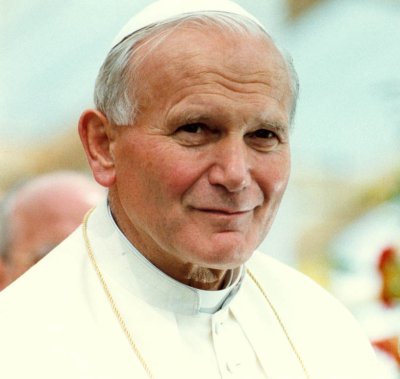
Have you ever seen this picture?


I was sent an email that contained this picture this morning.
Sometimes God sends both a man and a woman to call his people to holiness.

Benedict and Scholastica
Francis and Claire
Mary and Jesus

Our generation has these: John Paul the Great and Mother Teresa. One fell the scourge of communism. The other served the poor in India one person at a time. The influence of both will be felt for generations.

What I really like about this picture is the joy reflected in their faces. I get the sense that they aren't Brad and Angelina posing for paparazzi. They are expressing the hope that is inherent in their life of faith.

Sunday, March 22, 2009

We don’t need to earn God’s salvation but we still have to do good works

My Dear Brothers and Sisters in Christ
Grace to you and Peace in Christ Jesus, our Lord, as we continue on our Lenten journey of prayer, fasting, and almsgiving. In today’s readings, we hear three difficult passages that challenge our conceptions of God’s relationship to us and our relationship to God. In fact, the second reading and gospel are favorite passages of our Protestant brothers and sisters. You may recognize the gospel as the oft cited John 3:16 from sporting events, “For God so loved the world that he gave his only begotten son so that those who might believe in him might not die but have eternal life.” On the other hand, one could argue that the second reading from Saint Paul’s letter to the Ephesians was the passage that caused the Reformation. So, this Sunday more than most, I’m going to do something that I don’t normally do: I’m going to focus on a reading other than the gospel for this homily and see what we can understand from that reading that may help us understand better the gospel.
The letter of Paul to the Ephesians is very interesting, not the least reason being that the title may be a complete fabrication. Several scholars don’t even believe Paul wrote this letter, preferring it to have been written by one of Paul’s disciples after the apostle’s death and given his attribution since most of the theology was based on his teaching. Further, the letter may not have been intended for the Ephesians at all. The earliest manuscripts have no notation as to its destination. Marcion, an anti-Semitic early church heretic, said that it was to the Laodicians. Oftentimes, when Paul writes a letter to a specific community, there are names of people he has met there that he wants to greet. However, in this letter, he only ever greets one person, a fellow named Tychicus. Now, imagine for a second that you had lived in a town for three years and spent a lot of time with the leaders of the town helping them to convert to Christianity. You made tents during the day but you spent a lot of time at night and during both Sabbaths (Saturday for the Jews and Sunday for the Christians) evangelizing. Wouldn’t you think you would have a ton of people he would want to greet? I think, if anything, there were just too many to mention.
I mention these two controversies because I think they help us understand a bit of the controversy surrounding this letter and, perhaps, a bit of what we need to understand about this letter in our own day. If Paul did write this letter, he did it basically on his deathbed. And, he did so with a yearning for “better days.” And, he may have done so wishing that he could have done things a little better. You may remember from a few weeks ago, Paul had to defend himself against charges that he was lazy. He made a promise to return to the Corinthians and he couldn’t quite get there so he sent a second letter instead. Paul has regrets that he failed in ministry, that some didn’t hear the gospel because he couldn’t keep on evangelizing. Did Paul fail in gaining heaven because of this failure in ministry?
In some ways, in the passage we read from the letter to the Ephesians, Paul is answering the question of how much we have to do in order to earn salvation. Paul’s answer: there is nothing we CAN do to EARN salvation. Salvation is freely offered to us in Christ. He says, “For by grace you have been saved through faith, and this is not from you; it is the gift of God; it is not from works, so no one may boast.” It’s not as though my giving up pop for Lent has saved me. Jesus Christ’s death on the cross is the life-giving sacrifice that ends all sacrifices. He is the Lamb of God who takes away the sins of the world. He is the light that conquers all darkness. He is the word that breaks the silence of doubt. Jesus alone can save us.
And yet, does this mean that we are left entirely off the hook? Does it mean that the people who just spent an entire week serving the poor on spring break didn’t earn salvation by doing that? Yes it does. We can’t earn heaven. We can, however, cooperate with the gift that is offered to us. For, even though we don’t earn heaven by doing good works, Paul says in the very next sentence, “For we are his handiwork, created in Christ Jesus for the good works that God has prepared in advance, that we should live in them.” As believers, God points out to us certain things that we should do in order to grow in the grace that he offers us. Just like a gifted athlete or musician or architect or janitor still needs to train each day and grow in that gift, so we Christians must continue to grow in grace throughout our lives. And, the amazing thing is that God has kind of set us up for these good works. Even the good works we do are really prepared for us by God. The sense of injustice at seeing flood damaged areas after Hurricane Katrina has forced people to work for those who have been homeless for years. The sense of injustice at seeing places of deep poverty in our own country as is present the Appalachia mountains. The sense of injustice that our politicians take private planes while deriding those who come before them in the same private planes and while ignoring those who, in Washington D.C., are incredibly poor and destitute. The sense of injustice at seeing people in our own state ravaged by floods in Cedar Rapids being ignored while their homes and businesses remain abandoned and unlivable. God planted this sense of injustice in the hearts of some of our parishioners and it forced them to do good works. They heard the call of God to reach out in loving service to do good works for those in need in those places I listed and we thank them for representing this community and for listening so intently to God’s voice calling them to that service. But, thankfully, that call to do good works does not simply exist in these exceptional calls to go somewhere else and show God’s love to a foreign people. It happens in our daily lives, we just need to be intent enough to listen. That’s why the church continues the call that our Jewish brothers and sisters received so long ago. Prayer, fasting, and almsgiving. Prayer is where we hear the voice of God. Fasting is what leaves space in our crowded lives. Almsgiving is where we fill that space with the love of God lived out in good works. It is truly by grace that we have been saved through faith. It is not from us; it is the gift of God; it is not from works, so no one may boast. For we are his handiwork, created in Christ Jesus for the good works that God has prepared in advance, that we should (find eternal life) in them.

Monday, March 09, 2009

The Great American Novel

Please read the following post with the same seriousness that the conservative commentator Stephen Colbert gives to his television program. In other words, there's a core of truth (that I'm actually writing a book) but that there's a lot of fluff surrounding it (that I think it's going to be worth publishing/good).

Twain? Hemmingway? Poe? Garrison Keiller? Soon we will all wonder who in the heck any of these people are. I'm writing the Great American Novel! It's going to be my first foray into the genre and, considering how much of an incredible priest that I've become in the last 7 years, I'm sure I'll conquer this as well. It's a jaunty novel about a retired military priest that comes home to parish work and has to adjust to the egalitarian, bureaucratic model of contemporary parish ministry. It's sure to be on the New York Times best seller list as soon as it is written. I have three of the ten chapters done at this point so there is a lot of work to do. Of course, since I'm the hardest working guy in the area, I'm sure it'll be done weeks earlier than anyone else could get it done.

Saturday, March 07, 2009

Do you really want to be the beloved Son?

My dear Brothers and Sisters in Christ
Grace and Peace in God our Father and the Lord Jesus Christ through the power of the Spirit who calls us this week to the mountain be with you all. Last week, Fr. Ev very eloquently walked us through that place of testing that is the desert. He reminded us that each of us walk through the desert in one way or another in our daily lives. The desert is a rough place to have to walk. And Lent is nothing if not a desert. Yet, this week, I was relieved to hear that my readings were the mountain, the place of encounter with God. The mountain is where Moses encountered God in the form of the burning bush. The mountain is where, upon his return from Egypt having freed the people of Israel from slavery, God gave them the law. The mountain is where Solomon built the temple, that perennial place of encounter with God for our Jewish brothers and sisters. And, yet, there is a tradition about the place where Solomon built the temple, a tradition that this place was also the scene of the first reading, the sacrifice of Isaac.
The story of the sacrifice of Isaac is, for me, one of the most perplexing stories about God in the Old Testament. In order to test the father, you order him to kill his son. What was God trying to test in Abraham? His faith? I’d think there are better ways to test Abraham’s faith than telling him to kill Isaac. Try not hanging around for a while and see if he still acts like you matter, that’s what God did with Christian mystics like John of the Cross and Teresa of Calcutta. That can’t be right. Was he trying to test his trust? Abraham was a man who went for a very long time without having children. He trusted when God told him that he would be the father of many generations of believers. Abraham was nothing if not a person of faith and trust. What about his obedience? That seems more plausible, given the particular test that is offered. And, yet, I can’t help but feel that there is a more sane way of doing this than offering first-born sacrifice. I know that, if a father today were to approach me with the same assertion that Abraham is making in the first reading that God told him to kill his first-born son, I would be certain of one thing: God did not do that. God doesn’t want us to kill. God doesn’t need us to kill to show our obedience. God gave us life and wants us to live. So, what is happening here?
The question that surround this story is shared by our Jewish and our Muslim friends, by the way, though I suspect the conclusion we come to is slightly different than theirs. One thing we do know is that first-born sacrifice was much more common at the time of Abraham and Isaac than it was at the time of Christ and certainly than it is now. Most of the peoples surrounding Abraham and his tribe would have sacrificed their first-born son to appease gods. So, part of what his happening here is an open declaration that human sacrifice is not going to have a place with the followers of the one true God. And, yet, I couldn’t help but notice something from our Christian perspective that caught my ear. Isaac is called, “your only one, whom you love” which is kind of weird because Abraham had another son by his maid named Ishmael and, as any father will tell you, he probably loved both Isaac and Ishmael, even is his older son was a bit wild. It makes you wonder if Sarah had some kind of suspicion about Abraham’s intentions Such a suspicion, in fact, that she followed them up the mountain and hid behind a rock pretending to be God. Probably not but that would be a better sitcom explanation. As Christians, we hear this phrase “whom you love” and the phrase from the gospel, “my beloved Son” and we hear a connecting identifier, beloved. Both sons are loved by their father. Both sons are ordered by God to be sacrificed, Isaac to test his father’s obedience and Jesus to free the world from its sin. And, yet, even as we set up this comparison, we can hear our own hypocrisy. We cannot understand why God would order the death of Isaac and call it off at the last minute and we spend millennia trying to understand it. Yet, when God’s son was sent before humans to be judged, we had no clemency. Humanity collectively shouted, “Crucify him! Crucify him!” We needed Christ’s sacrifice because of our own iniquities, the beloved for the sake of those who forgot how to love.
On this Lenten mountain, we once again encounter the God who gave his life for us out of love, the just for the sake of the unjust. Let us remember that, all our prayer, fasting, and almsgiving is intended to make us more loving, intended to give us a heart closer to the beloved who gave his life for us.

Wednesday, March 04, 2009

A homily that is very late in coming

I preached this a week and a half ago, before Lent even began. But, I think it was good to help people prepare for lent?

Dear Brothers and Sisters in Christ
Grace and Peace from God our Father and Lord Jesus Christ be with you in the power of the Spirit that draws us all close to him who made us. Have you ever had one of those experiences in life in which God seemed so close to you that it almost felt like you were being embraced by pure love? For some of you it may have been receiving one of the sacraments, maybe in the midst of confirmation, receiving the sacrament of reconciliation or perhaps during your wedding ceremony. For others of you, it may have happened in the midst of an especially difficult time in your life such as a health crisis or a difficult relationship or work situation that forced you to turn to God who gave you peace in the midst of a storm. Still others may have experienced God on a retreat of some kind like the Antioch retreat that some of our students are on this weekend. In my own life, there have been many such times when God seemed so close that I could only feel privileged at being invited into the relationship. From the high of my ordination to the lows of times feeling like a failure with some grades in seminary, to the great retreat experiences I’ve had at Conception Abbey and St. Meinrads, I do feel blessed because of how close God was to me.
And, yet, if I were to look over my life, and I imagine most of you would say the same thing, there have been more times when God seemed an aloof, remote concept than times when God seemed so close that I could get a hug. It seems to me that our scripture passages want us to focus us in this mystery of transcendence and immanence. In some way, each of the readings warn us against attitudes that can get in the way of our relationship with God. Starting with the first reading, we hear the prophet Isaiah say something remarkable. The job of the prophet is to call people back to holiness. I’ll say this till I’m blue in the face. A prophet usually doesn’t predict the future inasmuch as tell people that if they don’t change, the future will be bad. The prophet usually wants to remind people of how good things were in the past so that they’ll stop doing what they’re doing in the present. But, in the passage we just heard, Isaiah tells his people not to think purely in terms of the past. In fact, something new is happening here! He says that in the past, people still grew weary of God, people still sinned. Isaiah even ties it into the Exodus event by reminding the people that, as their ancestors were being freed, they still complained that God wasn’t giving them enough food or good enough food. But, don’t we all have the tendency to do that; to make the past seem so much better than the present. It was so much easier to be holy in the past. We didn’t have the complexities that we do now. But, if we are honest with ourselves, it’s not the complexities that make it difficult to have a close relationship to God. It’s our use of those things. We cannot use an idealized view of history as an obstacle to God.
Next we hear from Paul in the second reading, a reading that took me a couple of times to understand what he was saying. I kept asking myself what he was talking about with all the “yes’s” and “no’s” and Jesus was all “Yes”. Well, Paul had promised to visit the Corinthians in the first letter and this letter is, in part, answering critics there that are basically calling him a liar. Paul is acknowledging that things didn’t go the way he was expecting but also acknowledging that, if he was supposed to get there, nothing would have stopped him from getting there. In some ways, Paul is having to get past past faults in order to evangelize to the people. Our past has a way of handicapping us from living in the present. We let past failures and regrets stop us from living life fully in the present. And, at times, we can feel most frustrated that, when we were failing, when it felt like we most needed God in our life, God was not there. It was like we were on that beach in the footprints poem dragging ourselves along instead of being carried by God. But, if that’s what happened, it’s only because we couldn’t let go of past hurts in order to have a good relationship with God.
Lastly, we reach the gospel. Last week, Fr. Schatz pointed out to us that we were going to hear another healing and so we did. I couldn’t help but ask this week: which is easier to forgive someone or heal someone. And, of course, it’s easier to forgive someone. But, this question that Jesus asks is really tricky for the scribes who knew the bible in and out. On the one hand, only God can forgive sins. But, on the other, in several places throughout the Old Testament, healing the lame is a sign of God’s presence among us. So, which is easier, something that only God can do or something else that only God can do? Then, Jesus goes on to do both of them. The scribes would have been infuriated! But, the amazing thing is that we know that the scribes view is the real problem. Forgiveness is the desire of God, God wants us to forgive one another. And, God doesn’t desire for us to be sick. He wants people to be healthy so that we can glorify him. The scribes were all too willing to put restrictions on God and what God wants. I think we do the same thing in our relationship to God. We wonder why God would want to love us, and demand a sign from him. Or, we think that prayer and holiness are the job of a few, not the vocation of all the baptized. We cannot let our own limited understanding of God stop us from loving God either.
As we draw closer to the great Lenten retreat that we begin this Wednesday, Ash Wednesday, let us not let an idealized view of history, all our regrets, or our limited understanding of God stop us from feeling God’s love but, instead, let us once again turn away from sin so that we can turn towards God.

Tuesday, March 03, 2009

Olberman on children

I like Keith Olbermann. I listen to his show each morning while working out. I agree with him on finances. I think that a flat tax would be terrible for this country and that trickle down economic theory is why this country is bankrupt. I'm not a socialist but I don't think democrats are either. They just believe those with more need to contribute more and those with less...well you follow right.

Okay, then he starts talking about moral issues and I get uncomfortable. In particular, last night he said, "...and yes, oh ye Puritans among us! Americans will pay for CONTRACEPTIVES. Taxpayer dollars for evil condoms and horrible birth control pills. Contraceptives for states that already have the option of providing for low income fornicators, fornication that would otherwise lead to untold, unwanted pregnancies, unwanted babies, unwanted abortions, unwanted drains on families, unwanted drains on the national economy. Yes. The congressional economic office estimates two hundred million dollars saved over five years for contraceptives and family planning...."

Here's my issue. I'm not being puritanical when I worry that contraceptives will destroy the world. I'm being Catholic. And I worry when children are seen as "unwanted". A child isn't some thing that you want or don't want. A child is a person that you get the privilege of raising. But, let's not miss the most insidious part. He said, "Contraceptives for states that already have the option for providing for low income fornicators..." You may have thought he was deriding the Republicans for their dislike of the poor. But, what I heard him saying is that the best thing the poor can do to be rich is prevent the expense of children and contraceptives will do that.

Margaret Sanger, founder of planned parenthood, thought that the way to get rid of minorities was by having them kill their babies. That's why planned parenthood is so abortion happy. Their founder was, why wouldn't they continue that on. I think Olbermann is echoing the sentiments of a lot of liberals, and it's what annoys me. To get rid of the poor, we need to have THEM kill their babies so they don't have a second generation.

Until we learn to see sex in its appropriate place within marriage and confined to that relationship and that marriage is the only place where new life should be introduced, we will continue to get this wrong. Sex isn't just one aspect of dating and abortion isn't the only way we've managed to hurt life. It all started when we devalued sex to the level of a recreational sport.

Tuesday, February 17, 2009

Marriages...and stuff

I was pretty proud of this homily I preached a my friends' wedding.

My Dear Friends in Christ
Let me begin with two apologies. The first is to Misty and Jacob. I lengthened the gospel that you chose and didn’t tell you. You had just chosen the end, the section called the “Great Commandment” and I decided to include the part about the Sadducees asking Jesus about resurrection by talking about the poor woman married seven times to seven brothers who has no children. I hope that in the course of this homily, you’ll see why I did that.
Also, I want to apologize to our Protestant brothers and sisters who are with us today in case you didn’t recognize that first reading. It’s one of those books that is in catholic bibles but was eliminated during the reformation. It’s one of my favorite books of our Old Testament, to be honest. It’s a story of intrigue, suspense, Angels, Demons, and even a fish that manages to give its life to save some people. If you’ve never heard of this story before, let me try to briefly summarize it. There was a righteous Jew named Tobit who was in exile in Babylon. Tobit was one who, when his fellow Jews were killed, would go out and bury their bodies in order to follow the prescripts of the law, despite the fact that the king didn’t like him doing this. But, this shows Tobit’s bravery and his faith. Unfortunately, Tobit goes blind and this causes strife between he and his wife, Anna, causing him to pray for death. Meanwhile, in a distant land, there was a young woman named Sarah who was also praying for death. She had been married to seven different husbands and none of them managed to live a single night with her as his wife. Thankfully, God heard the prayer of both Tobit and Sarah and sent the Archangel Raphael to help them. Tobit decides to settle his accounts with his relatives and sends his son, Tobiah, on journey and Raphael is his guide. Raphael not only proves to be a trustworthy guide but a God-send as he teaches Tobiah along the journey a way of curing his father’s blindness and driving the demon out of Sarah who is killing her husbands using the guts of a fish, a symbol of Christ for us Christians.
All of that precedes the present passage. Tobiah, newly married, has burned the incense to drive out the demon but he knows that, for the marriage to be sealed against further attack, they need to pray. So, Tobiah and Sarah get out of bed to pray before they lay their heads down to sleep. It’s a reminder of how important praying together is in any relationship, but especially in this most mysterious relationship of Marriage, a relationship that Paul talked about as being like Christ’s marriage to the church.
I think that you have to know about that story to know what the Sadducees are referring to in the gospel today, which is why I wanted to include it. Even though they are trying to use it to show how absurd the resurrection is, Jesus turns it to show something profound about human beings and something profound about himself. About human beings, Jesus says “At the resurrection they neither marry nor are given in marriage…” Now, I’m not trying to say that what we’re doing here has no effect in heaven. I don’t think that’s what he was saying. I think he was saying that either the marriage sticks here on earth or it won’t matter in heaven. In other words, either we get married here or we stay single for the rest of our eternal life. I was going to go around last night at the rehearsal dinner to get some examples of relationships that both of you have had that you’re now really glad they didn’t end in marriage but I decided that that could get a little too personal. Plus, you never know! They could be here. But, I imagine we all have had relationships that we give thanks to God each day that they didn’t end in marriage. It seems to me, Misty and Jacob, that God is saying that when it’s the right one, not only will you know but he’ll let you know that it’s the life-long one as well.
But, as I said before, Jesus is also trying to say something profound about himself. In that passage, Jesus is also showing himself to be the authoritative interpreter of scripture, which somewhat challenged the Sadducees but especially challenged the Pharisees who kind of felt like they had the market cornered on scripture interpretation. So, they approach Jesus and ask him to interpret scripture, basically boil down all 600 plus commandments to one. Jesus quotes Deuteronomy and Leviticus to Love God and Love neighbor. By combining these two commandments, we see Jesus putting forth another profound truth that a different evangelist, John, is infatuated with. He is basically saying that the same love the we show to God is the love that we need to show to each other. We need to be lovers of God and lovers our neighbor to truly show our faith. John will say that God is love, so the love we show each other is God himself. To quote Paul again from the second reading, this is a great mystery! It’s the mystery that, in some ways, draws us here. The love that the two of you show one another is the presence of God. It’s why we are so privileged to be here: Because in seeing you profess the love that God has given you that connects you together for the rest of your life, we see God. Thank you for the privilege.
With most couples, that’s where my reflection ends and I sit down. But, Misty and Jacob wanted us to go further and I would be remiss if I pretended like the only thing that was said in that second reading was that marriage is a mystery. Because, let’s face it. It’s a reading that is often misunderstood. It’s used by physically abusive husbands to subject their wives to hell on earth. It smacks of abuse if it’s not properly understood. The only way that you can understand it is in the way that Misty and Jacob have presented it to us: with an eye toward the profound sense of God’s love for us, the love that is Christ. Only if we see Jesus death and resurrection as the center piece of humility, only if we see Christ’s incarnation as the humbling of the exalted one so that we who are humbled might be exalted, does any of this make sense. Wives, die for your husbands just as the church must take up our cross daily and follow Christ. Husbands, die for your wives just as Jesus died for the church. Die to the need to be in charge. Die to the need to have power and authority, that original sin that plagued. Die to the idea that you are only worthy if you are successful in your job. Die to the idea that you are only successful if you have more stuff than your neighbor. Let love be the only thing that lives in your heart and then live in love.
Indeed, St. Paul was right, this is a great mystery, or sacrament to use a slightly different translation of the same word, a sacrament that we are privileged to witness today. May you draw deeper into this sacrament each day of your married life through the humble prayer of loving service that we see modeled in Christ.

Thursday, February 05, 2009

Will the real St. Thomas Aquinas please stand up?

I have to admit that, historically, I've not been a person that worries too much about the history and lives of the saints. It's only been recently (since going to the Benedictine Monastery) that I've felt really connected to the saints as arbiters of God's love for us.

I'm in St. Thomas Aquinas Parish, as most of you know. I've heard ad nauseum that St. Thomas didn't want to be a Benedictine because they were affluent and the Dominicans (the order he did eventually join) was still new, not well respected, and (most importantly) poor.

I listened to a podcast this morning called the saint cast (http://www.saintcast.org) and hope I learned a slightly different but nonetheless true, take on that oversimplification. The truth is that St. Thomas was born and raised a few miles from Monte Cossina, the abbey St. Benedict founded in Northern Italy. His Uncle was the Abbott of this monastery and it was assumed that St. Thomas would follow in his celibate uncle's footsteps. Also, the Holy Roman Emperor, a relative of St. Thomas, and the Pope got into a fight and divided the monastery. Both of them saw St. Thomas as a logical, intelligent Abbott who would bring together the sharply divided monastery.

St. Thomas, however, decided that he felt a call to more education, so he left for Spain. It was there that he got into contact with St. Albert the Great, an great Dominican teacher...and the rest is history.

So, what it tells me is that St. Thomas' conversion wasn't just about money and power, although you can argue that that's part of it. It was about someone evangelizing him without worrying about that. Someone finally figuring out that this man of incredible intellect and learning needed holy people around him to support him in holiness. I think we all need to learn from the simplicity of St. Thomas.

Wednesday, February 04, 2009

Reinstating a holocaust denier

This weekend, I decided to focus on forgiveness and unity for my homily. I talked about the lifting of the excommunication of the Society of St. Pius X. I mentioned the one bishop that is nuts, I almost used an offensive colloquialism to describe him but stopped myself, thank goodness. If you wonder what I almost said, it rhymes with "cat spit crazy".

Why would the Pope want us associated with this crazy bishop? I think it has to do with the fact that, despite his insanity, he's still a validly ordained bishop of the church who is leading people. And the fact that his fellow separated bishops were so embarrassed by his remarks that they asked him to silence himself.

I connected it to the idea of authority being used to heal people. Jesus is identified in the Gospel of Mark as having authority and that's why he heals. It is also why he is threatening to the powers that be.

Ultimately, this bishop will die and his ideas will die with him. But, his followers will continue on and will do so, not separated from the church but, hopefully, reunited with the church that fully acknowledges the holocaust and hopes that it will never happen again.

Friday, January 30, 2009

Moving toward #600

24 posts from now, I'll post #600. I feel like I want to do something big like suggest a new and vibrant look and direction for the blog. Oh, don't get me wrong! I'm obviously going to keep the core of what my blog is about but I feel like I need to get re energized and find a direction that will help me know how to post more. So, I'll be working on that in the next 24 posts in the hopes that I can set a direction that will help to direct posts 600-1000...or something like that.

Tuesday, January 27, 2009

St. Peter Claver

On my most recent trip to the Twin Cities, I attended mass at St. Peter Claver church, an African-American church in the Twin Cities. It was so odd because I ordinarily become very annoyed when a priest routinely ignores the rite and goes their own way instead. But, in this environment, it fit perfectly. The priest didn't stay still during the entire homily. He wandered all over church in an effort to make eye contact with every person there. It reminded me that I've become too accustomed to using notes for my homily. It's so much more effective if I don't. I need to work on that.

So, this weekend, I made an effort to write out my homily beforehand (though I still haven't put it here) and just look people in the eye while I was preaching. I haven't got that much reaction to a homily in a long time. I really need to make this a reality.

Tuesday, January 20, 2009

Being in the right place at the right time...

It's been two and a half weeks since I last celebrated a mass. I'm not bragging. I'm a little ashamed, to be honest. I've concelebrated several masses in those two and a half weeks, almost daily in fact. It's really odd, however, to go that long without celebrating a mass for people. It's rather unnerving, to be honest.

This past Sunday, I took a group of students to two churches in the Twin Cities. I sent one group to St. Agnes. It was their matronal feast and I guess they have switched from celebrating the current mass in Latin to the mass as it would have been celebrated prior to 1965. The students loved it. They were in awe. They said it was like heaven and earth touched and that they felt at home.

Two years ago, when I did this same type of experience, I sent the students to a rather liberal catholic church. The students were...let's call it upset. Angry would be closer to what they were. Unfulfilled at what had taken place. So, this year, I decided to take them to the black catholic church in the cities, St. Peter Claver. I brought them into this church the day before Martin Luther King Jr. Day and two days before President Obama took the oath of office. The liturgy was good. The priest's homily was spectacular. But, what hit me was that I was praying with people who have had a lot of reasons to feel betrayed and ashamed of how they have been treated by this country. But, for some there, they were going to feel as proud of this country as they ever have before. And, they were letting me be a part of that healing. It really was a honor to give peace to people there knowing that it means something different for them. It was a dream for the man whose martyrdom they celebrate the next day and a hope fulfilled for the man who was today elected.

Wednesday, January 14, 2009

Sorry for the long absence

I'm on retreat right now after going to a week-long conference. That's why I haven't blogged in a while. I'm hoping that things will return to normal next week.

Thursday, December 25, 2008

Good news of great joy

Dear Brothers and sisters in Christ

“For a child is born to us, a son is given us; upon his shoulder dominion rests.”

This verse from the book of the prophet Isaiah resonates deep into our soul this night of heavenly peace. We celebrate a birthday unlike any other. For most people, we only celebrate the birthdays of the living. After their death, we have a different day to remember them by. Yet, for this “Wonder-Counselor”, this “appearance of the glory of our great God and savior”, this savior born in the lineage of David, we continue the praises that began with the songs of angels to shepherds some 2000 years ago. This Son will be remembered for his life and so, each year, we feel compelled to remember when first God and Mary gave the world its redeemer.

We need to take this time because it will soon be over. It seems to me like these next two weeks pass with the speed of Santa’s reindeer. So much preparation goes into tomorrow. The children need to behave, or at least they’ll do so when mom and dad remind them that Santa’s watching. We all will (hopefully) get to sleep in heavenly peace this night but, before the last present is unwrapped, we have already started putting away the Christmas decorations that have been out since Thanksgiving day. We start our plans for New Years eve…just one short week away. Do we want to have the cheese dip in the crock pot all night and spend all New Year’s Day soaking it to get it clean? Did we remember to get a babysitter for the kids? Then, before we know it, it’s all over and the kids are still at home on their winter break while the rest of us go back to work. Or, worse yet, the kids go back to their normal lives with their own family and we remember, with fondness, that there used to be something different about this time of year, something that just isn’t different any more because we’re older. We need this night to be different.

I think of this tonight as we read this most famous passage of the birth of Christ. This passage has been immortalized by such great readers as Raymond Burr, Stephen Colbert, and even Charlie Brown. It has been dissected by scientists to prove or disprove its historical reality. But, at its core, the evangelist is trying to tell us something larger than scientific news. He’s telling “good news of great joy.” Mary and Joseph make the 90 mile trek from Nazareth in the Galilee region south to the miniscule city of David that is Bethlehem. They were going there because it was Joseph’s home town. This should have been a time of rejoicing. In a time in which travel was difficult, especially because they weren’t a family of wealth so they would have had jobs that demanded they stay in close to home, the fact that fancy pants Joseph is coming home with the woman he intends on marrying should have meant that everyone is putting on their Sabbath best and getting the best room in the house ready for their arrival. But, because of the census, everyone is coming home, all sixteen children of the sixteen children of the sixteen children. This town of limited space and resources suddenly is overpopulated such that the entire house, even the equivalent of a garage, would have been necessary for occupancy. That’s really where Joseph and Mary found themselves sleeping, in a room reserved for the animals since the rest of the house was taken. And, of course, this is when all the elements came together for the birth of Jesus. Mary wraps her son in straps of cloth and takes a deep pride in her newborn son.

Meanwhile, somewhere close by, the working stiffs of the world who had no idea what was happening, were informed by angels that they should be the first to visit the infant wrapped in swaddling clothes and laying in a manger. One wonders why the angels appear to them? These aren’t the mighty and powerful of this world. They also aren’t the poorest of the poor. They’re hardworking, middle-class folks that take a shower after work, not before. Jesus is literally surrounded by them this night in his parents, his extended family and, now, because of the message of angels, the shepherds.

It seems as though, throughout his ministry, he had a special affinity for them and people like them. He called hard-working fishermen to be his first disciples. He scorned the rich and powerful who were far too comfortable in this life calling them hypocrites. He looked with love upon the poor but never told his followers that it was their job to get rid of poverty. In fact, at points, he seemed to indicate that there will always be poor people. It’s almost as though Jesus knows that the ones who are most open to his message are the ones who most need to slow down their lives and get a view of the larger picture, the ones most in need of a Sabbath rest. The shepherds could easily get so fixated on protecting their sheep that they lose the sense of wonder and awe. Joseph’s family were so concerned with finding places for everyone and keeping everyone fed, that they lost their sense of charity. That’s the amazing thing about preoccupation: It makes it easy to neglect something important. When the chaos subsides and before you take down the decorations, take a minute or two and remember one thing. This is not a birthday party for a long-dead loved one that we just can’t quite stop remembering. This Christ mass is the birthday of the savior of the world whose birth was foretold by prophets and announced to common shepherds. It is a time for us to pause and give thanks to the God who came into this world to personally show us his love. I pray that each of you feel the song of praise the angels sang so long ago, “Glory to God in the highest and on earth, peace to those on whom is his favor rests!” May God bless each of you this Christmas Season!

Tuesday, December 23, 2008

The role of conscience in being a catholic on good standing.

This question is, oftentimes, raised regarding several “hot button” moral issues including abortion, gay marriage, war, euthanasia, stem cell research, etc. The classic example of this is a politician who claims to have a well-formed conscience who is told by his bishop that he cannot receive Holy Communion because he legislates contrary to a church teaching. Is the church trying to impair the politician from freely doing his job? Is the bishop justified in stating that the politician’s actions have excommunicated him? The easy answer to both questions is: It depends. The difficulty comes in defining on what circumstances it depends.

First off, I feel like I need to clarify a few terms. What do we mean by “informed conscience”? One can find a great definition of a conscience in the Catechism of the Catholic Church #’s 1776-1802. To abbreviate the content of those paragraphs, the conscience is “present at the heart of a person” to help guide a person in making moral decisions. Without the conscience, a person would not be culpable for his or her actions because it would be impossible to know right from wrong. A person spends a lifetime forming his or her conscience. The Word of God is key to the formation of conscience, though the church does not restrict the Word of God to just the Bible. The Bible is part of the larger Word of God but, ultimately, “We are assisted by the gifts of the Holy Spirit, aided by the witness or advice of others and guided by the authoritative teaching of the Church.”

So, in some ways, a fully formed conscience could not be in conflict with church teaching on issues on which the church has definitively decided, since it is what guides the formation of conscience. There are times in which a person, through no fault of his or her own, may not have a fully formed conscience. If the person was incapable, at the time of occurrence, of knowing what the teaching of the church was, they cannot be held accountable. Also, related to this, there is the prospect that a person is in the process of growing deeper in his or her understanding and is simply not to the point of learning (let alone accepting) a church teaching. In those cases, it’s possible that someone hasn’t yet had the church’s teaching on same-sex marriage or euthanasia explained to them or may have had an inadequate explanation. The person has an informed conscience but is ignorant of church teaching. Of course, it is the responsibility of the individual to seek out the full explanation of church teaching and not simply rely on ignorance as a rationale for not obeying the church.

Having said all of the above, there is room for legitimate disagreement with church authority if the church has not definitively stated a position on something or if the application of moral principles in a given situation is not entirely clear. For example, it is not legitimate to say that you wholesale disagree with the church’s teaching on abortion but are still a catholic in good standing. The church has been consistently clear that abortion violates the law of love and the dignity of the human person. But, if a pregnant woman has uterine cancer and would die without removing it, there is room for legitimate moral disagreement. Some moral theologians say that you are justified in removing the cancerous uterus since you are preserving the life of the mother and not intending on committing an abortion. Others disagree and say abortion is, nonetheless, an indirect result of the action and, therefore, it should not be taken. Oftentimes, the application of moral principles in complex situations is where moral theologians will disagree.

To know if something has been definitively decided, one should look toward the Catechism of the Catholic Church and official church statements. And, remember, not every statement that a priest, bishop or educated lay person makes is definitive. As a priest, I can tell you that I have very often been saddened by priests who either are unwilling to teach what the church teaches on tough moral teachings or who seem to believe that every statement they make is definitive.

Sunday, December 21, 2008

A first

I had to cancel the one mass I was supposed to preach at this morning because we're having extremely cold temperatures here in Iowa. I was going to preach about Mary and her important role in salvation history. I hope to slightly change it for my Christmas homily so I don't want to put it here, yet. But, I hope to have an answer I gave in my bulletin to a question of ethics and morals and such.

14 OT A: God gives the little ones rest.

Friends Peace be with you.  In the northern part of Israel, there is a place called Mount Arbel. It is located close to one of Jesus’ of...